BLOG
The Optimal DB Strategy for SMBs Building SaaS in the Vibe-Coding Era — Cloudflare D1 × Single-Tenant Smashes the DB Cost Wall
AI (vibe coding) has erased the cost of 『building』. Now the real question is the DB cost of running many services at scale.
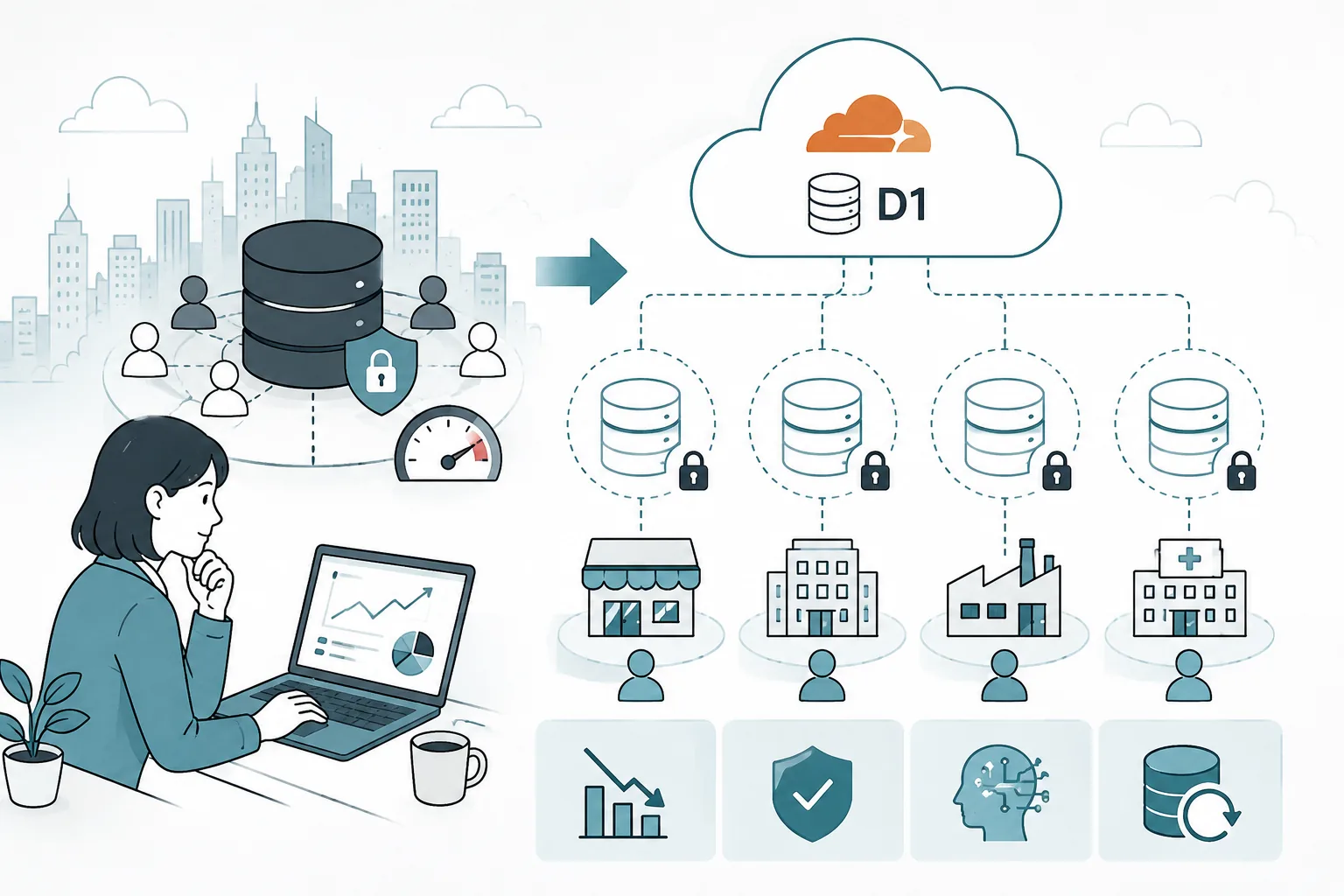
AI has driven the cost of “building features” toward zero. Even a small team can now ship the same features as a large company, at the same speed. And yet, the moment you launch a service, you run into the wall of fixed infrastructure cost — most notably, the cost of maintaining a dedicated relational database like AWS RDS.
I believe the shortest route for SMBs to operate large-scale SaaS today is to smash that wall head-on, using Cloudflare D1 and a single-tenant “one customer, one DB” strategy.
The “shove everyone into one DB” era is over
The reason large-scale SaaS has historically chosen multi-tenancy (every customer riding on a single giant RDB) comes down to almost one thing: RDS and Aurora fixed costs were so high that pooling was the only way to make the unit economics work.
But pooling always comes with a price.
- A breeding ground for security incidents: forget a single
WHERE tenant_id = ?and another company’s data spills into the response. No amount of review eliminates this risk to zero. - The noisy-neighbor problem: when one huge customer’s queries clog up the DB, every unrelated company slows down with them.
- Hard to leverage AI: when you want to feed RAG “only this customer’s data,” extracting it safely from a DB where every customer is mixed together is heavier than it looks. There have been real-world incidents of prompt injection reaching other companies’ data.
This structure is not something we should carry forward unchanged into an era where AI can build anything.
Cloudflare D1 changes the infrastructure assumptions
D1 is a serverless relational database built on SQLite, distributed across Cloudflare’s edge. What changes for someone mass-producing SaaS?
- Fixed cost is essentially zero: you don’t pay for idle DBs. You can leave 100 DBs running “just in case” and pay nothing while they sit empty.
- DBs can be created dynamically: every new contract becomes a single API call that spins up a dedicated D1 for that customer. Try doing the same on RDS and your finance team will object first.
- Seamlessly continuous with Workers: access from a Worker is essentially zero network hops. Multi-region reads come standard.
A single-tenant architecture that used to be “too luxurious to attempt” becomes the default choice on D1.
The overwhelming advantage of single-tenant (one customer, one DB)
When an SMB competes with a large vendor, this architecture doubles as a sales pitch.
You can say “they are physically isolated”
In B2B SaaS deals, the first thing IT and legal teams ask is “is our data separated from other companies?” Multi-tenant lets you say only “they are logically separated,” but single-tenant lets you immediately answer “the DB files themselves are different.” That goes straight to deal-close velocity.
AI / RAG becomes radically simpler
When each customer has their own DB, the scope of what AI is allowed to see is physically fixed from the start.
- “Read only this customer’s DB” is the entire instruction.
- Cross-customer queries are structurally impossible.
- Search precision improves too — less noise.
Rather than fighting to enforce RAG permission separation inside a multi-tenant DB, it’s faster, in the end, to separate the DBs first.
Data portability
When a customer says “we’re churning, give us our data back,” you hand over a single SQLite file and you’re done. No more building one-off export batch jobs every time. SaaS with a clean churn experience also tends to win re-contracts — that’s my personal observation.
The downsides, and the resolve required to overcome them
Of course it’s not a silver bullet. Single-tenant at scale has its own specific difficulties.
Migration automation is non-negotiable
“Adding a column to 1,000 DBs at once” becomes a routine operation. Manual work is impossible from day one — you need to own a migration runner with rollback and retry built in. Even if you let AI write it, this is the layer where humans absolutely review the final output.
Cross-customer analytics needs a separate pipeline
When asked “give me the monthly actives across all customers,” firing SQL against 1,000 separate D1s one by one is not realistic.
- ETL from each D1 into an analytics DB (DuckDB, BigQuery, ClickHouse, etc.).
- Aggregate on that side.
In short, separate OLTP and OLAP from the start. Multi-tenant tempts you to “do both in the same DB”; single-tenant forces you into the correct structure.
A “graduation plan” for customers who outgrow the model
Even in the single-tenant era, a single DB will sometimes hit capacity or QPS limits. Build in from the start a design where that one customer alone can be carved out onto separate infrastructure (a dedicated D1, or a differently configured RDS, etc.). Concretely: always interpose a layer that resolves “tenant ID → which DB to connect to.”
Whoever masters the infrastructure masters AI-era SaaS
In a world where the cost of “building” disappears, the deciding factor is “who can keep operating it cheaply, safely, and scalably?”
Piling AI features on top while still shackled to heavyweight RDS fixed costs will not make the unit economics healthy. Mass-produce DBs on Cloudflare D1, deliver customer-optimized value together with the peace of mind of single-tenancy. I believe this combination is the most realistic loadout for an SMB to legitimately call itself a large-scale SaaS operator.
At Wired & Eco Inc. we consult on SaaS development and migrations built around this architecture. Whether you are considering migrating an existing multi-tenant SaaS to single-tenant, designing a D1 migration, or operating migrations at scale, please feel free to reach out.